
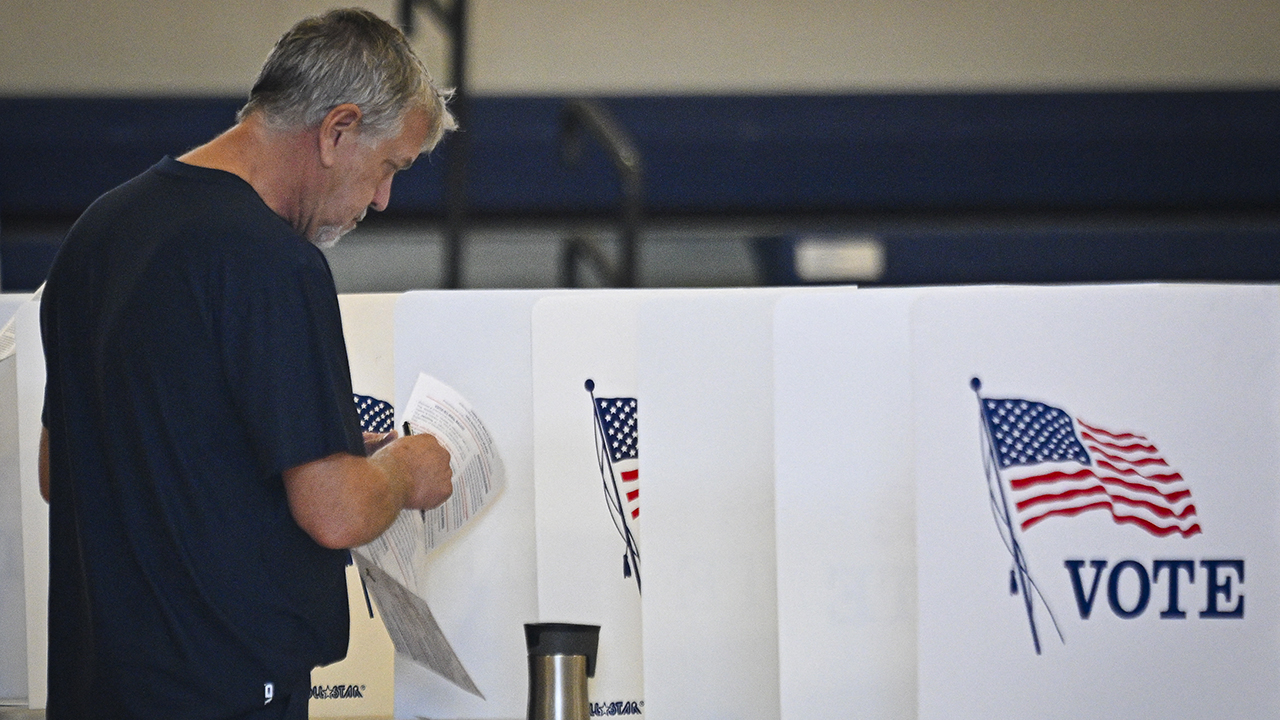
Affordability takes center stage as Americans cast their ballots in high-stakes midterms
Voters are casting their ballots in the midterm elections on Tuesday, with cost-of-living concerns in focus as Americans head to the polls.
A Fox News survey conducted Oct. 9-12 found that six in 10 voters said the cost of living is their top economic concern as they looked ahead toward Election Day.
A 74% majority of respondents to the survey gave the economy a negative rating, while 53% said they expect it to worsen next year. Just 18% of voters said their family is better off than two years ago.
Inflation is running well above the Federal Reserve’s 2% target rate, with the most recent consumer price index (CPI) showing inflation up 3.7% on a year-over-year basis in September. That increase was driven mainly by gasoline prices jumping 9.1% on a monthly basis and sitting 34.2% higher than they were a year ago.
REPUBLICANS COULD FEEL ‘SAME FATE’ AS DEMOCRATS AS ARE ELEVATED AHEAD OF MIDTERMS, EXPERT SAYS
Ben Lieberman, a senior fellow at the Competitive Enterprise Institute, told FOX Business that gasoline prices are playing a central role in voters’ assessments of affordability concerns in the economy.
“You can look at overall household budgets and motor fuels are only a part of that, but it’s the one thing that we know what we pay for down to the tenth of a penny, so it has an outsize influence on how people feel about the economy and whether things are affordable,” Lieberman said.
“Had it not been for the Iran war, I think the perception would be a lot better because gasoline prices would be lower,” he added.
IRAN WAR COSTS US HOUSEHOLDS $860 MORE IN HIGHER ENERGY PRICES, ECONOMIST SAYS
Lieberman noted that consumer inflation has eased in recent years relative to the post-pandemic peak of 9.1% that occurred in June 2022, but emphasized that prices generally aren’t going to return to the level they were at before that surge of inflation.
“One thing to keep in mind is the high inflation of years past. We don’t get a refund on that. Prices don’t go back to where they were, it’s like a new plateau. So there is the perception of high grocery prices, even though overall it may not be so bad,” he said.
Lieberman said that “people have to cut back on other things. I think you maybe saw a little bit of that last summer with people kind of downsizing their vacation plans, for example.”
Olivia Mitchell, an economics and public policy professor at the Wharton School of the University of Pennsylvania, told FOX Business that affordability is “one of the key topics of the midterm elections, creating a political challenge for Republicans who campaigned on bringing down prices and improving Americans’ well-being.”
Mitchell said that it’s “very clear that inflation has perked up again” after it had been on a downward trend from the post-pandemic peak of 9.1% in 2022. CPI inflation was as low as 2.3% in 2025 and began 2026 with a 2.4% reading in January, but has since risen to 3.7%.
DEMS CALL TRUMP ‘A TOTAL FAILURE’ OVER INFLATION AS WHITE HOUSE CITES ECONOMIC GROWTH
She added that households continue to face high mortgage rates, auto loans, credit card balances and other forms of consumer debt, which has made it more difficult for families to rebuild savings or prepare for retirement.
“The tariffs are definitely making much of what we consume much more expensive, and this is leading to consumer frustration, which is, in turn, I think, going to be reflected in the midterm elections,” she added.
“Ultimately, the affordability debate will force policymakers to move beyond broad claims about economic growth and to demonstrate much more convincingly how their policies will improve the financial security in everyday lives of our households,” Mitchell said.

